01 Techno-Vernacular Expressionism
02 Saecularhythmia—The Rhythmanalyst relates to semiocoustic reason.
03 …beyond the broken beat
04 Chaosmosis
05 Sense-Datum Volumetrics
06 Synoptic Audio
07 GLO//A (Global Latency Optimization // Acceleration)
08 Teleoplexy
09 Oogie Boogie
10 Dhalgren (Nihilism is Not Enough)
DeForrest Brown, Jr.’s final piece as Speaker Music – is Synoptic Audio.
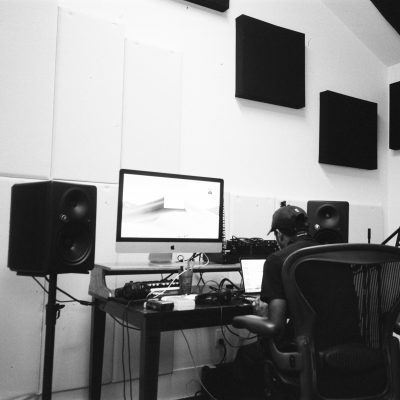
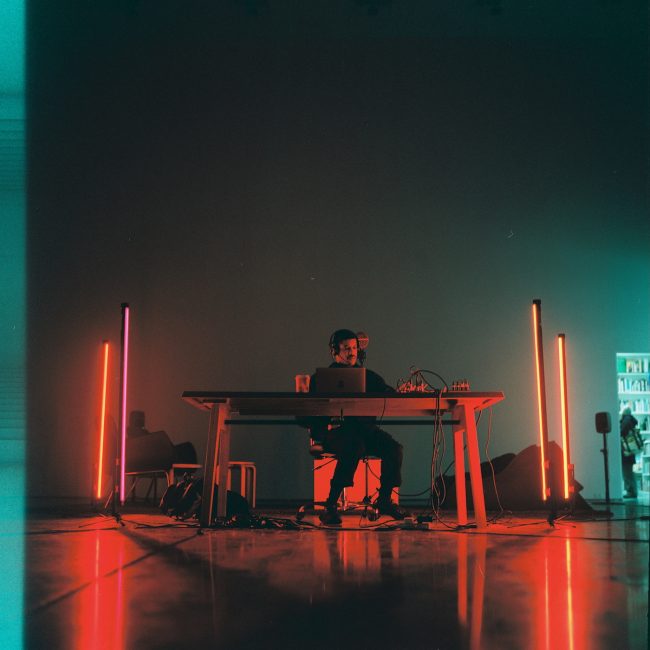
It’s ‘Theory first’ music that invites the listener to think about the presentation of sound through musical systems. The album is made of live recordings of electronic improvisation, essentially a self-made palette of dense, transporting Lydian drone that underscores a nexus of techno and Brown’s background in performing trumpet and tuba in marching/concert ensembles at the level of practice. It sounds like a symphonic arrangement of shoegaze/post-rock via dubwise hi-tech jazz, drawing inspiration from Black electronic music pioneer/nuclear weapons specialist Don Lewis’ pre-MIDI ‘Live Electronic Orchestra’ controller system, and other machines he helped develop including the TR-808 and DX7. DeForrest approximates post-MIDI electronic instrumentation with a portable, multichannel breakout workstation composed of iPad, MacBook and mixer that tune and harmonize haptic clones of keyboards, synthesizer effects modules, and rhythm units that embody the swing and bounce of trap and footwork hi-hats, toms, and kick-drum racks as a “live” contraption drum line.
Before Synoptic Audio, Speaker Music releases were composed of compressed files exported directly from the DAW, which in turn, excluded much of the spatial acoustic qualities that occur in the live sonic environment. Open studio residencies at EMPAC (Experimental Media and Performing Arts Center) at Rensselaer Polytechnic Institute in Troy, NY and Libby Leshgold Gallery at Emily Carr University of Art + Design, in Vancouver, BC between 2024 and 2025 allowed space for DeForrest to experiment with ambisonic motion capture technology to consolidate and exfoliate the latency, compression, and overtones between the live and studio moment.
Synoptic Audio is an experiment in the studio-as-instrument logic of Miles Davis’s electric period or A Guy Called Gerald’s Black Secret Technology, where post production editing, overdubbing and spatial manipulation are a crucial part of the music. The initial percussive mic checks, playback and re-editing of live demonstrations took place in EMPAC’s Studio 1—Goodman, where the material was spatialized using IRCAM Panoramix and recorded binaurally through a Neumann KU 100 dummy head microphone, (literally a mannequin with mics as ears) to record sound exactly how human ears hear it in 3D space. Then these recordings were taken to Libby Leshgold Gallery, where they were edited and re-recorded through a four-speaker Genelec array and subwoofer into a 360-degree ambisonic microphone to capture how the room’s walls and ceiling change the sound, making the effects of the room part of the iterative recording process in which fidelity, feedback, distortion and phase cancellation is treated as an analytic tool to expose how sound behaves within a perceived “auditory scene” when it’s not being optimized for efficiency, commerce and format.
Rather than resolving into definitive compositions, Synoptic Audio remains open to an emotive reconfiguration. Capturing how sound moves through space and hits a human body. These processes are a way to keep changing the music, rather than just documenting it, keeping it open and alive.